
Is Peel & Stick Wallpaper Safe for a Nursery? GreenGuard Gold Explained
Is Peel & Stick Wallpaper Safe for a Nursery?
Short answer: yes — if it’s printed with certified low-VOC inks, and you know what the certification actually means. The long answer is worth five minutes, because “non-toxic” gets stamped on a lot of products that have never seen the inside of a testing chamber. Here’s what GreenGuard Gold certification really tests, why it matters more in a nursery than anywhere else in your space, and what to check before you put anything on the wall a metre from a crib.
What GreenGuard Gold actually certifies
GreenGuard is a chemical-emissions certification run by UL Solutions, one of the world’s oldest safety-science companies. Products are placed in a sealed environmental test chamber and the air around them is measured — not the ingredients list, the actual air. Testing follows the UL 2818 standard for chemical emissions from building materials, finishes and furnishings, and screens for emissions across more than 360 individual VOCs, with methods that can detect over a thousand.
There are two tiers, and the difference matters:
- GreenGuard (standard) caps total VOC emissions at 500 µg/m³ — written around office environments.
- GreenGuard Gold caps total VOCs at 220 µg/m³, less than half the standard limit, adds stricter individual chemical limits including formaldehyde, and is aligned with California’s CDPH Section 01350 health-based criteria — the benchmark written specifically for sensitive occupants. Gold is the tier specified for schools and healthcare facilities.
That last point is the one to remember. Gold doesn’t mean “a bit better.” It means tested against limits designed for the people most affected by air quality: children, the elderly, and anyone sensitive. Our inks carry GreenGuard Gold certification — the nursery-grade tier, not the office-grade one.
VOCs, explained for tired parents
VOCs (volatile organic compounds) are chemicals that evaporate into the air at room temperature — the source of “new paint smell” and “new car smell.” Common ones in decorating products include formaldehyde, toluene and xylene. In high or prolonged doses they’re linked to headaches and respiratory irritation, and children are more vulnerable than adults: they breathe faster, their lungs are still developing, and in a nursery they sleep 12+ hours a day in the same few cubic metres of air.
You can’t shop your way to zero VOCs — almost everything emits something, including solid wood. What you can do is choose products independently verified to emit very little. That’s the entire purpose of emissions certification, and why “tested air” beats “non-toxic” marketing copy every time. Our peel-and-stick wallpaper is printed exactly this way.
Why a nursery is the worst-case room
A nursery concentrates every factor that makes emissions matter. It’s usually the smallest bedroom in the house — the box room in a Toronto semi, the second bedroom of a Montreal Plateau walk-up — so any emission accumulates in less air. The door stays closed for naps and the night. In a Canadian winter the windows stay shut for five months straight, so air exchange is minimal exactly when the baby arrives (there’s a reason so many nurseries get decorated in February). And the occupant spends more hours in that room than anyone else in your space spends anywhere.
Small room, closed door, sealed winter, maximum exposure time. That’s precisely the scenario the Gold tier’s 220 µg/m³ limit and CDPH alignment were designed around — which is why it’s the only tier we’d put our name behind for kids’ rooms. Browse the full kids & nursery wallpaper range to see what’s printed to this standard.
The PVC question
Our two peel and stick materials are Type II vinyl printed with GreenGuard Gold certified inks — waterproof, washable, removable. For parents who want to avoid vinyl entirely, we also print on a 270gsm PVC-free non-woven (CA$4.28/sq ft), a paste-the-wall material rated for 15+ years. Same designs, same Vancouver printing, no PVC.
A fair way to choose: if the nursery wallpaper is staying up through several kids and a decade, the PVC-free non-woven is the natural pick. If you’re a renter, or you suspect the dinosaurs will need to become something cooler by age seven, peel and stick’s clean removal wins.
Built for what kids actually do to walls
Certification covers the air; vinyl covers the crayon. Both peel and stick materials are washable — porridge flung from a high chair dragged into the nursery, sticker residue, the inevitable wall-as-canvas phase all wipe off with a damp cloth and mild soap. A painted nursery wall in builder’s flat paint survives none of those.
One practical note for new builds and fresh renovations: let new paint cure at least four weeks before applying peel and stick. Ironically, the fresh paint is emitting far more than the wallpaper at that point anyway. Our application guide covers surface prep in detail.
And when they outgrow the woodland animals
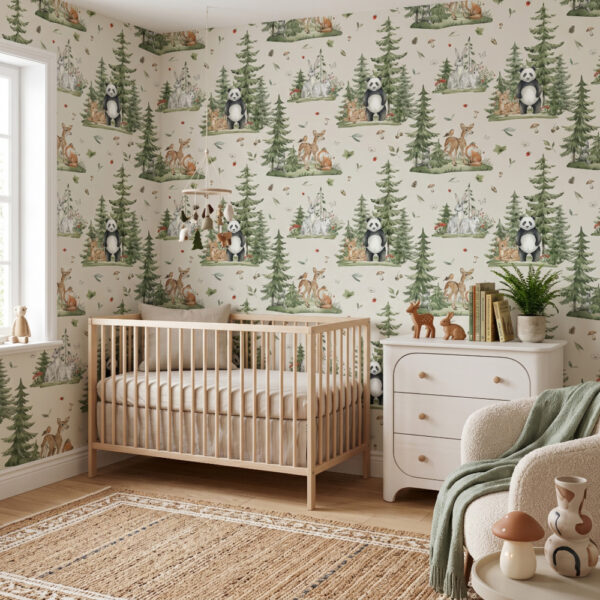
They will, around the same week you finally finish paying attention to it. Peel and stick removal is the whole exit strategy: start at a top corner, pull down slowly at an angle, and panels come off whole — no steamer, no chemical stripper sloshing around a child’s bedroom, no repaint. About 15 minutes per wall, then the room is ready for the big-kid phase.
That removability changes the economics of decorating for children at all. A kids’ mural sized to one wall behind the crib is a few hundred dollars, not a renovation — so it’s allowed to be age-specific, and allowed to be temporary. Have your own illustration? Create your own nursery mural from it.
The nursery checklist
Before buying any nursery wallpaper, from us or anyone:
- Ask for the certification tier by name. “Eco-friendly” and “non-toxic” are marketing; GreenGuard Gold is a test result. Ours: Gold.
- Order a swatch first. Our 24-inch swatches are CA$8 — check the colour beside the crib in daylight and under the nightlight, and test adhesion on your paint.
- Decide vinyl vs PVC-free based on how long the design will stay up.
- Time the install a few weeks before the due date if you’re also painting, so everything has cured and aired with windows open.
- Preview it. The room visualizer on every product page shows the design on a photo of the actual nursery wall, scaled.
Everything we sell is printed to order at our Vancouver studio with GreenGuard Gold certified inks and ships in 2 to 5 business days — no duties, no border fees, free shipping over CA$300, and 30-day returns. The nursery is the one room where the certification paperwork genuinely matters; happily, it’s also the most fun one to wallpaper. Common questions are answered in our FAQ.
Sources: UL Solutions: UL GREENGUARD Certification · UL Solutions: What Does “GREENGUARD Certified” Mean? · Johns Manville: The 3 Tiers of GREENGUARD Certification · Aeroflex USA: What is GREENGUARD Gold Certification?